

Crocodiles in Costa Rica: here’s where to find them in 2024
The only survivors – together with some birds – of the mass extinction that occurred in the Cretaceous period 66 million years ago, Costa Rican crocodiles are imposing animals that largely resemble their dinosaur ancestors. In Costa Rica, a territory with a rich and varied fauna, there are many specimens that live in the numerous waterways scattered across the country. However, there is a very famous town that boasts a special observation point to admire these beasts which can reach 7 meters in length. It is no coincidence that the crocodile is the symbol adopted by the community.
As luck would have it, we saw a majestic specimen just a few hours before our return to Europe.
Tarcoles, the city of crocodiles
Returning from Manuel Antonio (heading to San José to catch the plane), we were driving along the Costanera Sur in our Toyota Corolla Cross (thanks Juan). Suddenly we noticed that a rather crowded group of people were leaning over the parapet of the Crocodile Bridge with a fascinated and curious look.
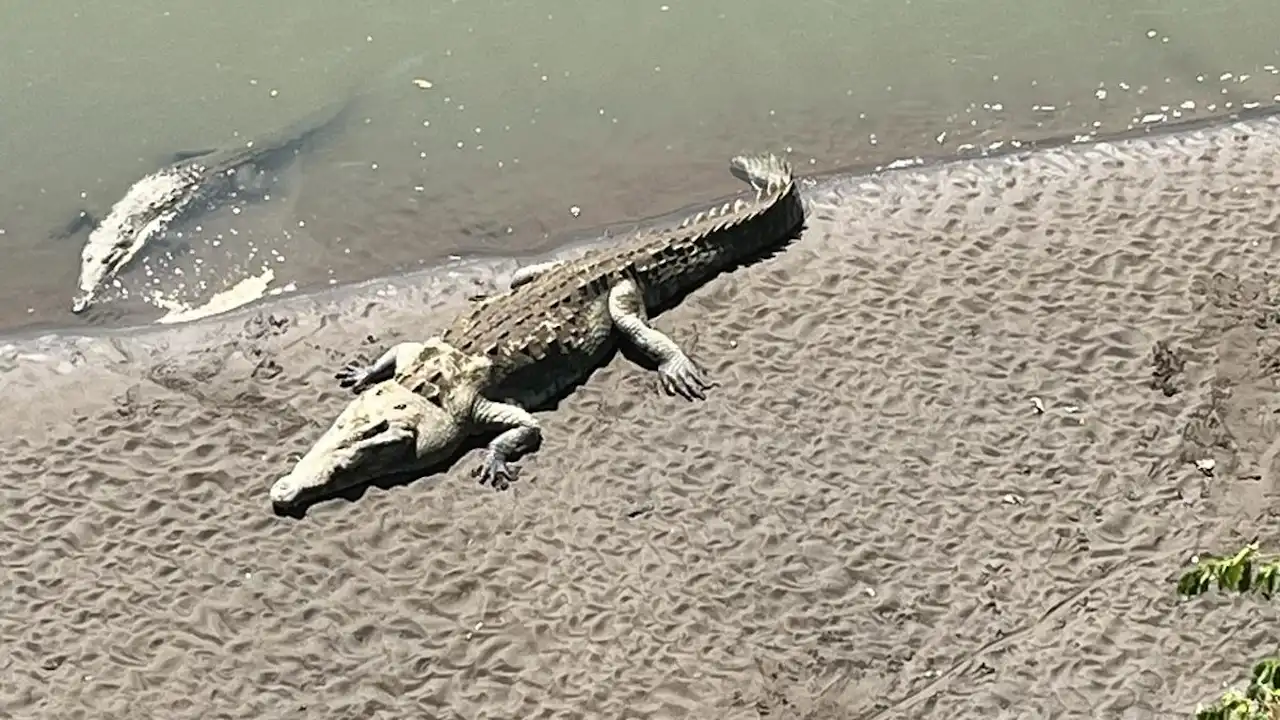
We were well ahead of the flight departure time to Rome, so we decided to take a short break to check out what was going on. After having refreshed ourselves at the Restaurante Los Cocodrilos we reached the bridge: the structure is equipped with a pedestrian sidewalk so you can walk along it in complete safety. We were surprised when, peeking over the parapet, we spotted 6 crocodiles on the banks of the Tarcoles river.
One of them was incredibly larger than the others and was resting under the sun probably waiting for the best moment to eat something. Seeing such a specimen was a unique experience, especially as a last gift before returning to the old continent. Although crocodiles are fearsome predators, observing them up close (so to speak) is like diving into very distant times that we have only known from school books. From above it was then possible to admire it in all its extension, being among other things out of the water on the river bank.
Costa Rican crocodiles, like all crocodiles, are very fast animals even on dry land. The banks of the Tarcoles river are easily accessible, but it would be foolish to go down to the bank, so don’t do it! You will find a fixed Policia patrol, which in addition to protecting the banks, protects the crocodiles themselves from poaching. These reptiles are among the animals that have claimed the most human victims.
Costa Rican crocodiles are protected species
These poor animals have been persecuted for centuries in search of their skins, their meat and their teeth. Since 1975, thanks to the Washington Convention, reptiles and amphibians have been slightly more protected. However, intensive farming to produce leather in any case requires puppies and specimens of reproductive age, so it is not unusual for crocodiles to be taken from their habitat or killed. It has also been discovered that crocodile fat may be the optimal ingredient for the production of biodiesel, which could put the species at risk in the long term.

Is it rare to see a crocodile in Costa Rica?
Yes, it is quite rare to see a crocodile in its habitat. Mainly for two reasons: they are animals capable of hiding and in the 20th century they were practically decimated. Crocodiles populate swamp waters and river estuaries, but it is not usual to come across these “dinosaurs”. In the national parks of Costa Rica there are numerous waterways that could host these reptiles, such as the Rio Suarez of the Cahuita national park, the Rio Naranjo near Manuel Antonio and the Rio Uvita, near the Ballena Marino Park.
In any case, in Tarcoles there are many organized tours available to admire crocodiles in the wild, but since we have not tested them first hand we will not make any suggestions.
How to reach Tarcoles?
To get to the Crocodile Bridge in Tarcoles you have two main options:
By car
If you have rented a car, you can easily reach the Crocodile Bridge by entering these coordinates into your navigator.
By bus
From San José you can take the San José – Jacó line served by Transportes Jacó, which allows you to purchase tickets online for around $5.00.
If you’re coming from the south, the Dominical-Jacó line should be right for you.